
2 Life Skills to Teach Kids Before They Leave School. And Change the World by Doing it.
Life skills kids are missing when they leave high school
(originally published on Medium.com, 29-Aug-2024)
Is it just me or does it seem like young people enter adulthood unprepared for daily life?
No doubt, you can think of three or more things to respond with “Oh yeah, people should know …” This isn’t a “Kids these days don’t…..” article.
I am thinking more education fundamentals.
I know we can’t change the world overnight but I think there are two things we could initiate whose impact can truly change lives, futures of families, communities and, dare I state, the world as well.
While the list of deficiencies in modern life and education would likely be quite long if we surveyed 100 people, I’m not trying to eat an elephant in one bite. I am referring to:
- Personal Health
- Personal Finance
I have no formal training or certifications on the above topics, but I experienced the school of life (student for over 55 years now and counting). I’ve seen how these two topics impact so many aspects of our lives.
Throughout my adult life, even since my 20’s, I noticed a pattern that the health and finance can be linked to many of life’s daily problems brought up in discussions. I can’t quote figures for the added stress on a person or family, but I think health and finance issues contribute a notable amount to stress in a household.
As an engineer, personal health and personal finance just seem so obvious as two areas to improve people’s knowledge and experience for personal well being. In doing so, so many of life’s self-inflicted problems that compound into larger problems could be reduced or eliminated.
Personal Health
As seen in the graphic below, obesity is quite high on a global level. This graph shows 2016 data as the latest available from Our World in Data.
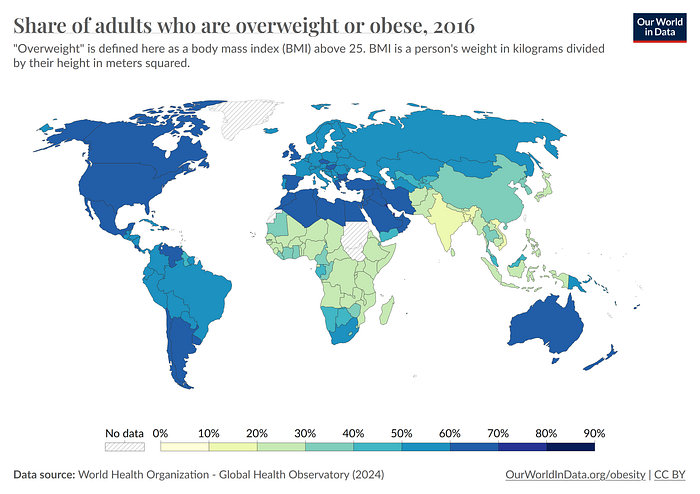
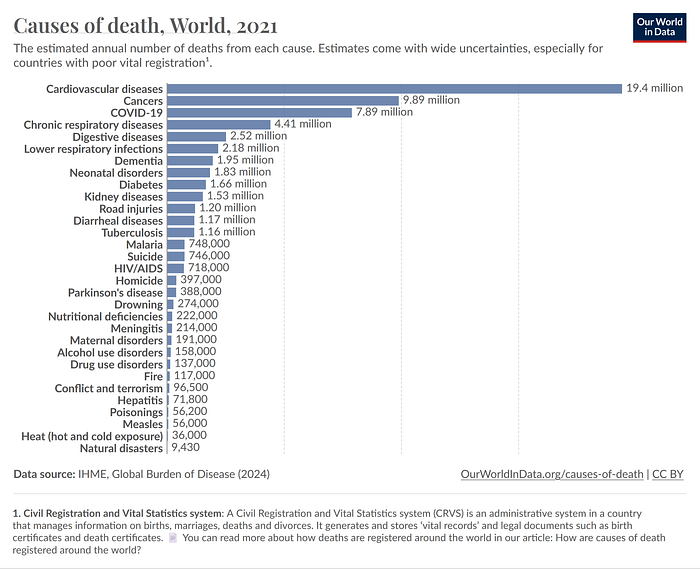
It’s easy to find information online linking obesity with heart disease, diabetes, high blood pressure, sleep apnea, high cholesterol, and other chronic conditions. Many of these are risk factors for cardiovascular disease, which was the leading cause of death in the world in 2021 as shown below.
Obesity is a major problem. That is stating what most people intuitively know.
Sadly, it contributes to the second topic below (Personal Finance) as medical insurance, doctor visit co-pays, prescription drugs, lost work time all impact your personal finances.
No intended disrespect to health and physical education teachers, I believe young adults leave high school without adequate education and guidance to maintain their health and fitness, as a practical life skill.
Personal Finance

As my son finishes his last year of high school, I have heard in many parent conversations the subject of how students leaving high school have not been educated to manage their own personal finances.
This seems to extend from the most basic action to balancing a checkbook (or digital equivalent) to managing their money regardless of their future pursuits (directly into the work force or to higher education).
It’s quite easy to quickly get into unsustainable debt at an early age, if you are not keeping an eye on your overall financial plan and status.
For me, personal finance was never discussed while I was growing up.
Again, no disrespect to high school teachers, but I don’t think personal finance, as a life skill, is addressed sufficiently before young adults graduate from high school.
What can we do?

Teach Personal Health and Personal Finance as Fundamental Subjects in School
All school children and young adults should receive instruction on both personal health and personal finance as they relate to life skills and knowledge to be a functioning adult.
The instruction should be embedded into schools like other fundamental courses (math, science, English, history).
Integrate age-appropriate information into elementary, middle and high school for an increasing educational content and to promote knowledge retention and opportunities to practice what is taught.
Integrating this information into existing subjects may be the easiest way to get exposure and framework rather than creating new classes. Math classes address the numbers; Science classes address the nutrition, etc.
Stage the information where introductory concepts are presented then expanded on in subsequent grades. Build the knowledge base.
Educational experts are the right people to develop these programs, based on guidance from health and financial experts whose expertise can provide the technical information and key messages to share.
As these are both life skills, it seems like there’s an opportunity to make personal health and personal finance to be fun subjects in school by relating as much as possible to the students’ daily lives.
Regarding Personal Health
Education is needed with practical application and examples. This means interactive discussions about nutrition and food selection examples for a balanced diet, not just high-level guidance.
Engaging with local communities is likely necessary to account for cultural food traditions. You don’t want junior coming home to tell Grandma he won’t eat her signature dish because it’s not healthy.
Fitness and exercise are obviously also key elements to a personal health program.
I’m not an expert on children or young adult personal health, so I’m deliberately not outlining the specifics to address. The experts needs do that.
Regarding Personal Finance
Trying to be as brief as possible, I think the following personal finance topics should be integrated into the high school curriculum:
- Income and paying taxes
- Expenses
- Making a budget based on income take-home pay and expenses
- Managing financial institution accounts (e.g., savings, checking, digital applications, brokerage accounts, retirement accounts)
- Managing periodic (monthly/quarterly) bills and paying on time
- Rainy day ‘emergency’ funds
- Financing higher education
- Managing credit card usage and risks associated with them
- Starting your life long savings habits as soon as possible
- Defining your personal goals (e.g., travel car, house, children, retirement, etc.)
- Investing
- Learning self control on spending impulses
- Credit scores and bankruptcy
This isn’t meant to be an exhaustive list, but to illustrate the point that young adults may not have the knowledge or awareness of some of these topics.
But, as I got my first full-time job (see article here), I learned more about these and the topics above became more relevant to me.
Make Mentor Connections
To help make personal health and personal finance more fun as noted above, I think mentors over groups of students are a fantastic way to encourage life style integration and promote community interaction.
I remember participating in Junior Achievement in high school and the personal connection to the subjects they shared made it very memorable.
Takeaways
I’m not an expert, but sharing my views based on my life experiences.
Personal health and personal finance are fundamental to our lives. Improving people’s education and practices in these areas will contribute to reduce many of society’s problems in these areas.
Personal health and personal finance are fundamental life skills. Fundamentals need to be taught and reinforced in the same repeating way as subjects such as math, science, history and English are taught.
Don’t let social media posts dominate the space – some offer great tips but that’s not universal.
Today’s schools can’t afford to add more classes to the curriculum. But, as a society, can we afford to keep the status quo?
To be clear, I am in no way diminishing other significant educational needs like universal pre-K or equality in education across the world. I’m just highlighting two topics that I think are part of the root problems to many of the long-term issues that people face. And, maybe better education in these areas will nudge the trajectory of folks’ lives in the right direction.
And the future?
Close your eyes and imagine if both personal health and personal finance were integrated into education in some form.
It’s a longer term view for sure; it’s not the typical high school grading period or fiscal quarter results.
Imagine the potential for better personal health for your children and their families.
Imagine people having more control of their financial destiny versus reacting to mistakes that could have been prevented.
What will that world look like in five, ten, twenty years? I think personal health and personal finance are notable contributors to a person’s happiness. And, this can translate into improvements in families, communities and overall cultures.
Dare to dream.

Until schools catch up with this idea, here’s hoping you as a student of life seek out education to become sufficiently informed for your circumstances to achieve your best personal health and personal finance situation, while sharing your experience and knowledge with younger generations.
Enjoy Life and Thanks for Reading,
-Jeff